Your Car Still Starts. That Does Not Answer the Safety Question.
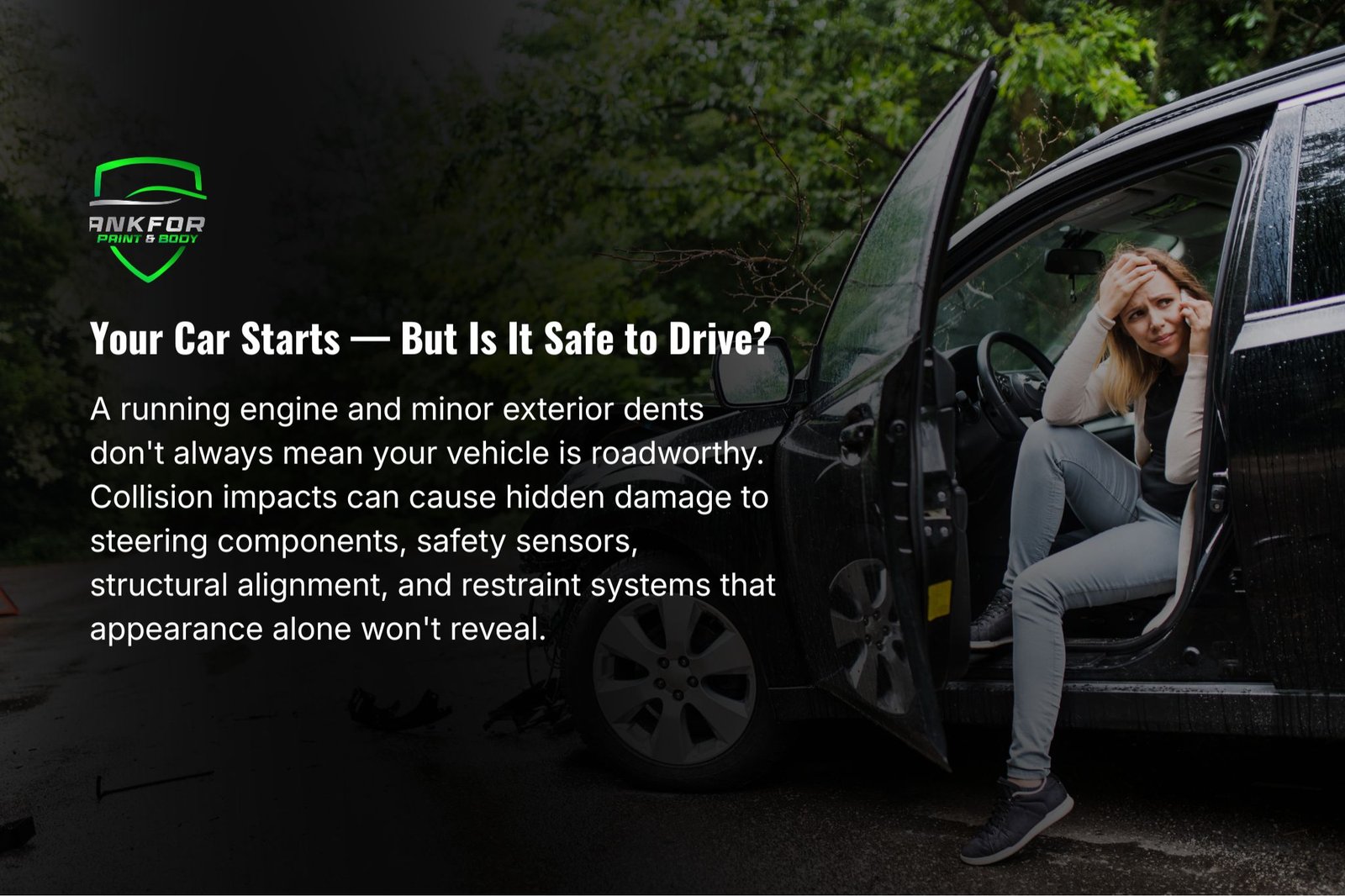
Your vehicle starts, the wheels still turn, and the exterior damage may not look severe. It is tempting to assume you can simply drive home and deal with the repair later. But if you are asking Can I drive my car after an accident, whether the engine starts is only one part of the decision.
Collision damage can affect steering, wheels and tires, lighting, glass, body components, restraint systems, and areas hidden behind exterior panels. For Prairieville and Ascension Parish drivers, Lankford Paint & Body provides collision and body repair, including professional damage evaluation and written estimates. The shop’s current website lists free estimates and towing coordination when a damaged vehicle will not drive.
The safest answer is not a remote yes or no. Visible appearance alone cannot establish whether a collision-damaged vehicle is roadworthy. If something affects normal control, visibility, wheels, tires, lighting, restraint systems, or the security of body components, stop treating the question as “Can I make it home?” and move toward professional assessment or towing.
Can I Drive My Car After an Accident? Start With What Changed
Before thinking about the distance you need to travel, think about what changed because of the impact.
Warning signs that deserve professional evaluation include:
-
The steering feels different or the vehicle pulls to one side
-
A wheel or tire is rubbing against damaged bodywork
-
A wheel appears out of position
-
Fluid is leaking underneath the vehicle
-
Broken glass interferes with visibility
-
A bumper, fender, hood, or other body component is loose
-
Exterior lighting is damaged or no longer operating correctly
-
A door, hood, or trunk no longer closes or latches normally
-
Airbags deployed
-
There is significant deformation around the impact area
-
You are unsure whether the vehicle can be controlled normally
Louisiana law states that a vehicle should not be driven on a highway when it is in an unsafe condition that endangers a person or property. Louisiana Legislature
This is one reason a website, photograph, or phone conversation should not be used to declare a particular damaged vehicle safe to drive.
When Should I Tow My Car After an Accident?
If you are asking Should I tow my car after an accident, towing becomes the more appropriate next step when there is a meaningful concern about operating the vehicle normally.
Arrange towing rather than continuing to drive when:
Steering or handling has changed.
A car pulling after an accident can have several possible causes. The exterior appearance alone cannot tell you whether the concern involves alignment, suspension, a wheel, a tire, or another collision-damaged component.
A tire or wheel is contacting damaged bodywork.
A bent or displaced panel can interfere with tire movement even when the vehicle still rolls.
There is active fluid leakage.
Do not try to identify an unknown leaking fluid by continuing to drive the vehicle.
Visibility is compromised.
Broken glass after an accident can create problems beyond appearance if the driver’s sightline is affected or damaged glass is unstable.
A body component is loose or will not latch.
A loose bumper after an accident, an unsecured hood, or another damaged exterior part can require evaluation before normal driving.
Airbags have deployed.
NHTSA states that deployed airbags can only be used once and should be replaced before the vehicle is driven again.
Review NHTSA airbag guidance
Moving Out of Traffic Is Different From Continuing Your Trip
There is an important distinction between moving a vehicle out of an active travel lane and deciding it is appropriate for normal driving.
Louisiana law states that after an accident, when the driver is not prevented by injury, the vehicle is not disabled, and the crash has not resulted in serious injury or death, the driver should move the vehicle from the travel lane to the nearest safe shoulder.
That requirement should not be interpreted as proof that a damaged vehicle is suitable for driving home, commuting, or continuing a trip.
At an active crash scene, follow law enforcement and emergency instructions. Once the immediate roadway situation is handled, the next question is whether the vehicle needs towing or professional inspection before normal use.
Why Minor-Looking Collision Damage Can Need More Inspection
A bumper scuff, small dent, or shifted panel gap does not automatically mean serious structural damage.
It also does not prove there is nothing else to inspect.
I-CAR’s exterior damage-analysis guidance recommends inspecting the complete vehicle, beginning at the primary impact and continuing into adjacent areas. It also notes that suspected structural damage may require further inspection and identifies inoperative lighting or a deployed restraint system as potential reasons a vehicle may be unsafe to drive.
Review I-CAR exterior damage-analysis guidance
If the accident changed panel gaps, door operation, steering behavior, or other aspects of the vehicle, Lankford’s guide to signs that may indicate structural damage after an accident explains why those symptoms are reasons for inspection rather than a remote diagnosis.
If your vehicle has been hit and you are uncertain whether the visible damage tells the whole story, Lankford Paint & Body can inspect the collision damage and provide a written estimate. If the vehicle does not feel safe to control or cannot be driven normally, arrange towing rather than driving it to the shop simply for an estimate.
A Simple Towing Versus Assessment Framework
Use this framework as a decision aid, not as a remote roadworthiness test.
Tow the vehicle
Towing is the stronger choice when you have:
-
Deployed airbags
-
Fluid leakage
-
Wheel or tire interference
-
Abnormal steering or handling
-
Significant body deformation
-
Glass damage that affects visibility
-
Loose components that may detach
-
A hood, door, or trunk that cannot be secured
-
A vehicle that cannot be controlled normally
Get professional assessment before returning to normal driving
Assessment is appropriate when:
-
The collision affected a wheel, suspension area, bumper, or body opening
-
Warning lights appeared after the impact
-
Panel alignment changed
-
A door, trunk, or hood operates differently
-
You are uncertain whether something underneath the visible damage was affected
Do not rely on appearance alone
Even if the damage seems cosmetic, a photograph cannot inspect components behind a bumper cover, wheel area, exterior panel, or trim.
The right question is not simply Is my car safe to drive after a collision based on what you can see. It is whether anything about the vehicle’s operation, visibility, safety equipment, or damaged components requires evaluation before normal use.
A Prairieville Example
Consider a Prairieville driver involved in a front-corner parking-lot collision.
The bumper has visible scraping, and one corner has pulled away slightly. The engine starts, and the vehicle can move.
However, when the steering wheel is turned, the driver hears rubbing near the damaged corner and notices that the vehicle feels different.
The appropriate next step is not to drive around the block to see whether the problem disappears. Wheel or tire contact and changed steering behavior are reasons to stop and have the vehicle professionally assessed.
After inspection, the repair may turn out to involve only exterior components, or additional damage may be identified. The example does not assume structural damage. It shows why the vehicle’s behavior matters more than whether the bumper damage looks minor.
For more information on what may happen after inspection, see Lankford’s guide to how the collision repair timeline works.
What to Bring for a Post-Accident Collision Estimate
Once the vehicle is safely at the shop, having the right information can make the estimating process easier.
Bring or provide:
-
The vehicle
-
Year, make, and model
-
VIN when requested
-
Photos taken after the collision
-
A short explanation of how the impact occurred
-
Insurance estimate, if one already exists
-
Claim number, if applicable
-
Notes about steering, rubbing, warning lights, closure problems, or other changes you noticed
Lankford’s current estimate form accepts vehicle information, VIN, a description of what happened, and optional damage photographs.
You can use the Lankford Paint & Body free estimate form to provide those details.
Get the Vehicle Evaluated Instead of Guessing From the Damage
If you are still asking Can I drive my car after an accident, avoid using a photo, the fact that the engine starts, or the size of the dent as proof that the vehicle is ready for normal driving.
Lankford Paint & Body provides collision and auto body repair in Prairieville and currently offers free estimates. Its website states that no appointment is needed for an estimate during normal business hours, and towing can be coordinated when a damaged vehicle will not drive.
Lankford Paint & Body
38173 Post Office Rd
Prairieville, LA 70769
Call (225) 241-8904 to explain what happened and request a free collision repair estimate. If the vehicle cannot be safely controlled or has one of the warning signs above, arrange appropriate towing instead of driving it to the shop for assessment.
This article provides general vehicle-safety information and is not a remote roadworthiness determination or individualized legal advice.
FAQs
Can I drive my car after an accident if the damage looks minor?
Visible appearance alone cannot confirm roadworthiness. If steering, wheels, tires, visibility, lighting, airbags, body components, or other vehicle behavior changed after the collision, have the vehicle professionally evaluated before normal driving.
Should I tow my car after an accident if the airbags deployed?
Yes, towing is appropriate. NHTSA states that deployed airbags must be replaced before the vehicle is driven again because an airbag can only deploy once. NHTSA
What should I do if my car is pulling after an accident?
Do not keep driving simply to test whether the pulling disappears. Changed steering or handling can have several causes and requires professional assessment to determine what the collision affected.
Can a loose bumper make a car unsafe to drive?
It depends on the actual damage and how securely the component remains attached. A bumper or other body component that is loose, interfering with a tire, or at risk of detaching should be professionally evaluated rather than judged from a photograph alone.