The Part Listed on Your Insurance Estimate May Not Be the Only Option
Your insurance estimate says “aftermarket,” the body shop mentions OEM, and suddenly a simple parts line has become one of the biggest questions in your collision repair. Which part should actually go on your vehicle?
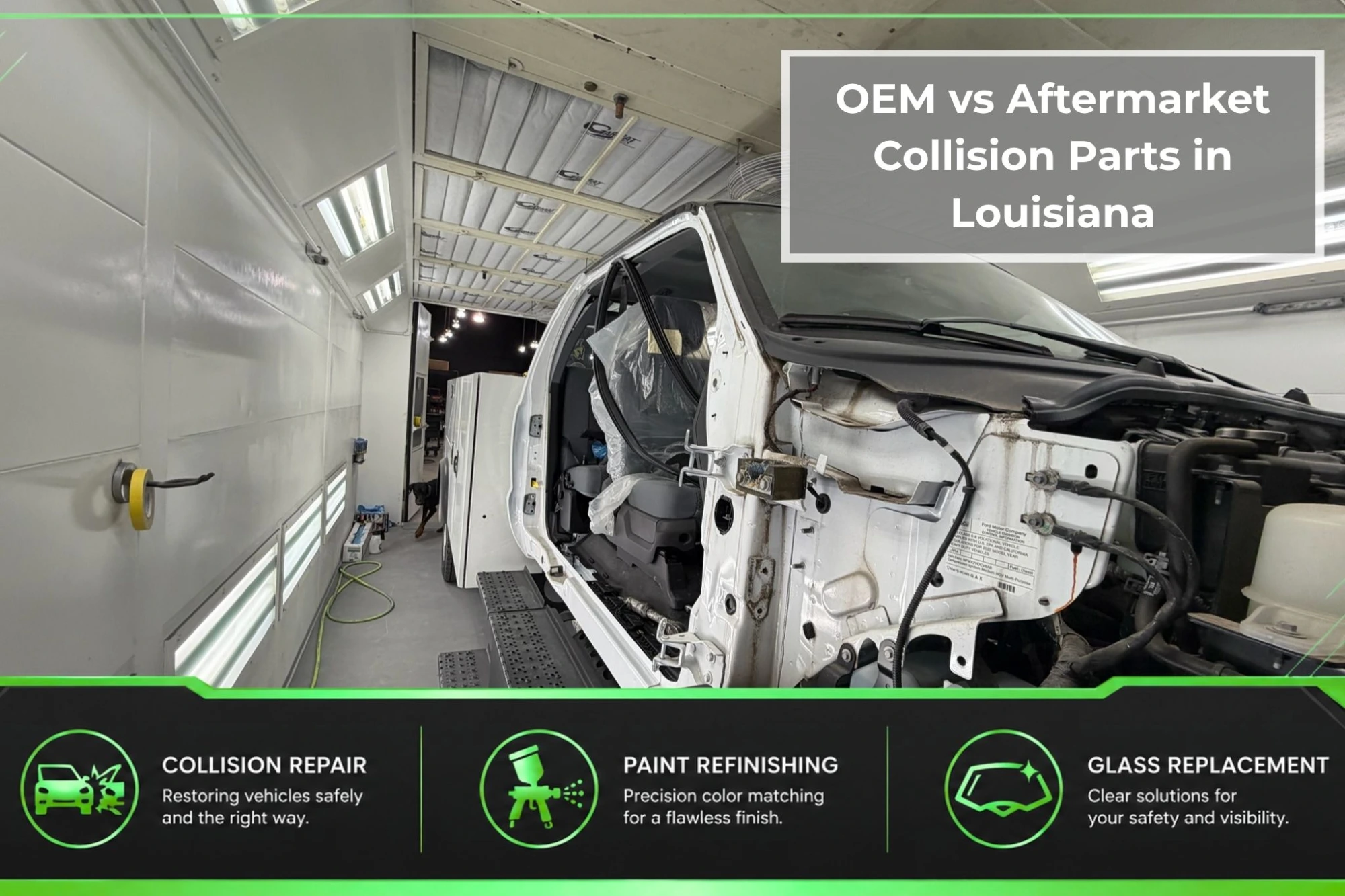
The answer is not that OEM is automatically right for every repair or that aftermarket is automatically a bad choice. When comparing OEM vs aftermarket parts in Louisiana, drivers need to look at the specific vehicle, the damaged component, manufacturer repair information, insurance coverage, availability, warranty terms, and what is actually written on the estimate.
For Prairieville-area drivers, Lankford Paint & Body currently handles collision repair, written estimates, supplements, paint work, and insurance-related repair coordination. The goal should be to understand the proposed repair before authorizing it, including which parts are being used and why.
What Do OEM, Aftermarket, Recycled, and Reconditioned Mean?
Before comparing parts, it helps to understand that collision estimates can contain several different categories.
OEM Parts
OEM means original equipment manufacturer. In collision repair, an OEM replacement part generally comes through the vehicle manufacturer’s parts system and is intended for that make and model.
That does not mean every repair automatically requires OEM parts. Vehicle-specific procedures, insurer policy terms, part availability, customer preference, and the damaged component all matter.
Non-OEM Aftermarket Crash Parts
Louisiana law defines a non-OEM aftermarket crash part as an aftermarket replacement for certain nonmechanical sheet-metal or plastic vehicle parts that was not made for or by the vehicle manufacturer. This definition is important because Louisiana’s crash-parts statute is not simply a blanket rule covering every component on a vehicle. Louisiana R.S. 51:2422 definitions
Recycled or Salvage Parts
These are previously used components removed from another vehicle. Depending on the component, vehicle, condition, and repair requirements, recycled parts may sometimes appear on a collision estimate.
Remanufactured, Rebuilt, or Reconditioned Parts
These terms generally refer to previously used components that have undergone work intended to restore them to usable condition. The Louisiana Department of Insurance’s consumer guidance distinguishes these categories from new and recycled parts.
The useful question is not simply, “Which category is best?”
Ask:
What part is being proposed for this vehicle, why was it selected, and is it appropriate for this repair?
What Louisiana Law Says About Aftermarket Crash Parts
Louisiana has a specific disclosure requirement when non-OEM aftermarket crash parts are involved.
Under Louisiana R.S. 51:2424, an insurer cannot specify non-OEM aftermarket crash parts, and a repair facility or installer cannot use them, unless the insured is advised in writing.
When an insurer intends for non-OEM aftermarket crash parts to be used:
-
The written estimate must clearly identify each applicable part.
-
The insured’s estimate must include or have attached the statutory disclosure explaining that those crash parts come from a source other than the vehicle manufacturer and that applicable parts warranties come from the part manufacturer or distributor.
You can review the current statute directly through the Louisiana Legislature’s aftermarket crash-parts disclosure law. The Louisiana Department of Insurance also reiterates this requirement in its current consumer guidance.
That disclosure requirement is one reason Louisiana drivers should read the individual parts lines on a collision repair parts estimate, not just the total at the bottom.
Does Louisiana Law Require OEM Parts?
Not as a universal rule for every collision repair.
The Louisiana Department of Insurance states that vehicle owners can request OEM parts, but depending on the claim and circumstances, the owner may be responsible for a difference in price. Coverage and payment can depend on the policy, claim, proposed repair, and other facts. Louisiana Department of Insurance accident guide
That means OEM collision parts insurance questions should be handled case by case.
Before authorizing a repair, ask your insurer and repair facility:
-
Is the insurer paying for the proposed OEM part?
-
If not, what alternative is listed?
-
Is there a customer-pay difference?
-
Does current manufacturer repair information affect the choice?
-
Is the proposed part currently available?
-
What warranty applies?
Do not assume the insurer must automatically pay for every OEM part requested. At the same time, do not assume the first part listed on an insurance estimate is necessarily the final repair decision.
Manufacturer Repair Procedures Can Affect Parts Decisions
Parts selection is not purely a pricing decision.
Modern vehicles can contain structural components, sensors, brackets, bumper systems, restraint-system components, and other parts that interact with the vehicle as a system.
I-CAR’s repair guidance emphasizes following the vehicle manufacturer’s procedures for the specific year, make, model, and component rather than applying one generic method to every vehicle. I-CAR guidance on following vehicle-maker procedures
That is why a body shop may need to research current repair information before determining whether a particular part source or replacement method is appropriate.
It is also why this article should not be read as saying:
-
OEM is always required.
-
Aftermarket is always acceptable.
-
Recycled parts are always unsuitable.
-
The cheapest part is automatically the correct choice.
The actual repair comes first.
What Should You Look for on a Collision Estimate?
If you are comparing OEM vs aftermarket parts in Louisiana, do not simply compare the final dollar amounts.
Review each relevant line and ask:
-
What part is being replaced?
Know whether you are looking at a bumper cover, fender, lamp, reinforcement, bracket, door component, or another part. -
How is the part identified?
If a non-OEM aftermarket crash part is intended for use by the insurer, Louisiana law requires clear identification and the applicable disclosure. -
Why was that part selected?
Ask whether the decision is based on availability, insurer estimate, repair procedures, cost, customer preference, or another factor. -
Is there manufacturer-specific repair information?
Some components may be subject to more specific vehicle-maker requirements. -
What warranty applies to the part?
Do not assume every replacement part carries the vehicle manufacturer’s warranty. -
Is there a price difference if you request another part type?
Ask before authorizing work rather than discovering the difference later. -
Could the parts list change after disassembly?
Hidden damage can reveal components that were not visible during the first estimate.
If your insurer’s estimate already lists unfamiliar parts terminology, Lankford Paint & Body can review the vehicle and explain the repair scope before work begins. The shop’s current collision repair services include estimates, supplements, adjuster communication, and collision repair from minor to heavier damage.
Why the Insurance Estimate and Shop Repair Plan May Differ
A parts difference does not automatically mean either side is wrong.
The insurance estimate may have been written earlier in the claim, before complete disassembly or repair research. The shop may later identify:
-
Additional damaged components
-
A different vehicle configuration
-
Changed parts availability
-
Manufacturer-specific procedures
-
A repair-versus-replacement issue
-
Another part needed to complete the repair
Lankford’s guide to why an insurance estimate may be lower than the body shop estimate explains how parts, labor, hidden damage, and repair operations can cause the two documents to differ.
If the repair scope changes after additional damage is identified, that may also lead to a supplemental estimate rather than forcing the repair to remain identical to the first document.
A Prairieville Example
Consider a Prairieville driver whose front fender and bumper are damaged in a collision.
The insurer’s initial estimate lists a non-OEM aftermarket fender. The estimate identifies the part and includes the required Louisiana disclosure.
During repair planning, the shop reviews the vehicle information and relevant manufacturer procedures. The owner asks whether OEM is available and whether requesting it would create an out-of-pocket difference.
Instead of assuming one answer applies to every repair, the shop and customer can now compare:
-
The proposed aftermarket part
-
OEM availability
-
Manufacturer information
-
Applicable warranty terms
-
Insurance coverage
-
Any customer cost difference
-
Fit and repair requirements for the actual vehicle
That is a much more useful way to evaluate OEM vs aftermarket parts in Louisiana than choosing based only on the label.
Questions to Ask Before Authorizing Collision Parts
Bring this checklist to the estimate review:
-
Which replacement parts are OEM?
-
Which are non-OEM aftermarket?
-
Are any recycled, salvaged, rebuilt, or reconditioned?
-
Is each non-OEM aftermarket crash part clearly identified?
-
Did I receive the required Louisiana disclosure?
-
Does the manufacturer publish a procedure or position affecting this component?
-
What warranty applies to each replacement part?
-
Is the part currently available?
-
If I request OEM, will I owe a price difference?
-
Could disassembly reveal additional parts needs?
-
Will I be contacted before an unexpected customer-pay amount is authorized?
For additional Louisiana claim context, Lankford’s guide to choosing your own body shop in Louisiana explains written estimates, repair-shop selection, parts disclosures, and insurer communication.
Understand the Parts Before You Approve the Repair
The most useful way to compare OEM vs aftermarket parts in Louisiana is not to treat one category as universally right or wrong.
Start with the damaged vehicle. Review the written estimate. Identify the part category. Check the required disclosure. Consider the vehicle manufacturer’s current repair information, availability, warranty, insurance terms, and any customer cost difference before authorizing the work.
Lankford Paint & Body provides collision repair and insurance estimate coordination for Prairieville and surrounding communities. Current site information confirms free estimates and states that customers can bring a vehicle in during normal business hours without an appointment.
Lankford Paint & Body
38173 Post Office Rd
Prairieville, LA 70769
Call (225) 241-8904 to discuss your collision damage or have an existing insurance estimate reviewed before repairs begin. You can also send the vehicle, VIN, damage details, and photos through the free estimate form.
This article provides general collision-repair and insurance information and is not individualized legal or insurance advice.
FAQs
Are aftermarket collision parts legal in Louisiana?
Yes, non-OEM aftermarket crash parts can be used, but Louisiana law requires written notice to the insured. When an insurer intends to use them, the written estimate must clearly identify each applicable part and include the required disclosure.
Can I request OEM parts after an accident in Louisiana?
Yes. Louisiana Department of Insurance guidance says vehicle owners can request OEM parts, but the owner may sometimes be responsible for a price difference depending on the claim and circumstances.
Are OEM parts always required for collision repair?
No universal rule makes OEM parts mandatory for every repair. Part selection should consider the specific vehicle, damaged component, current manufacturer repair procedures, insurance terms, availability, and customer authorization.
What should I do if my insurance estimate lists aftermarket parts?
Read the individual parts lines, confirm that applicable non-OEM aftermarket crash parts are identified, review the disclosure, and ask the repair facility why the part is being proposed. If you prefer OEM, ask whether it is available and whether there would be a customer-paid difference before authorizing repairs.