That Scratch May Be Small, but the Repair Depends on How Deep It Goes
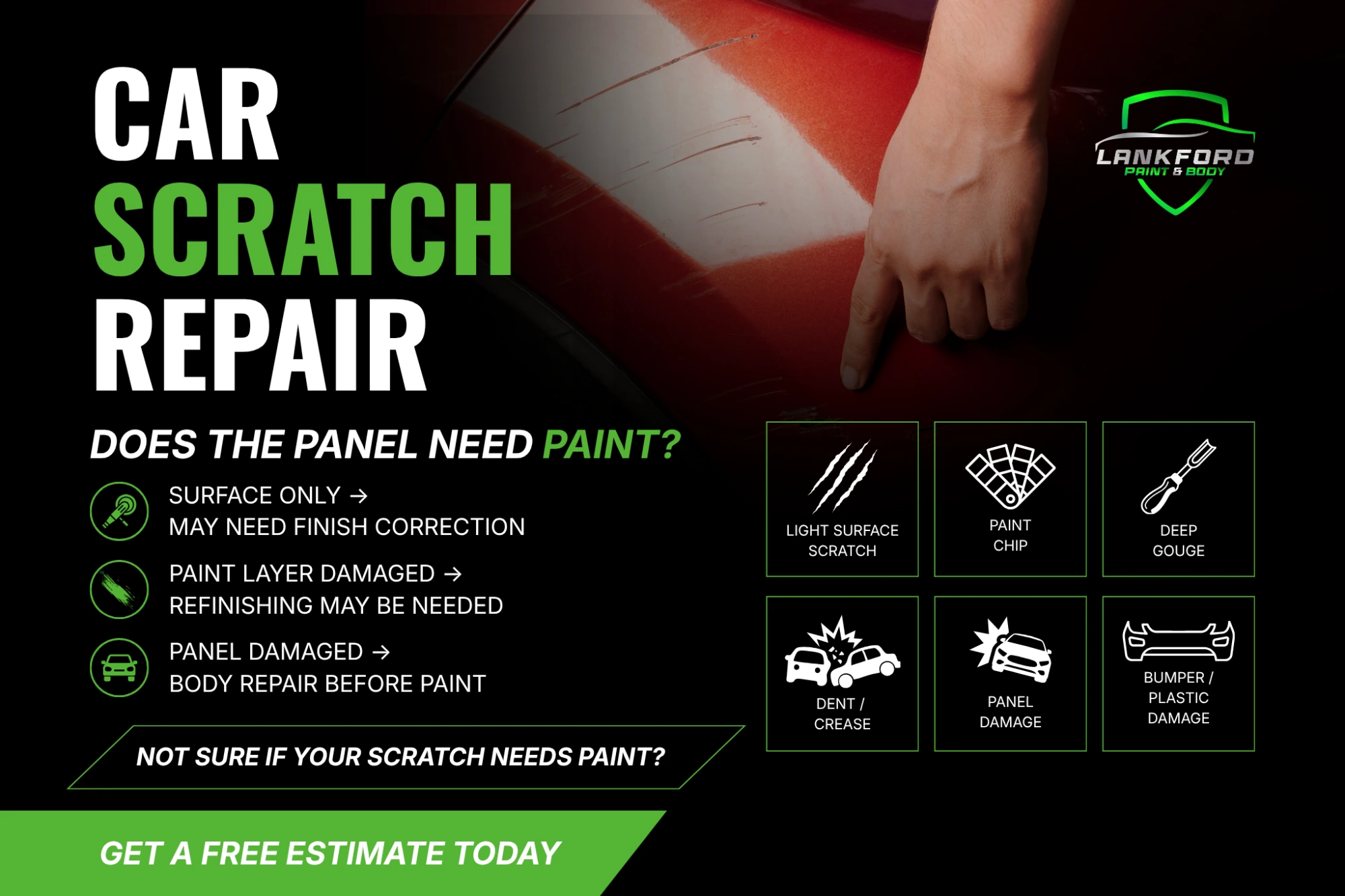
A scrape down the side of your car does not automatically mean the entire panel needs to be repainted. It also should not automatically be dismissed as something that can simply be polished away. The right car scratch repair depends on which layers of the finish were affected and whether the impact also damaged the body panel underneath.
A light surface mark may require a very different repair from a deep gouge that reaches the color, primer, metal, plastic, or a dented panel. For Prairieville-area drivers, Lankford Paint & Body currently provides paint refinishing, panel work, dent repair, and collision repair, with free estimates available through its Prairieville shop.
The goal of an inspection is to answer a more useful question than “Can you paint this?” It is: What was actually damaged, and what repair is appropriate before any refinishing begins?
When Does a Car Scratch Actually Need Paint?
There is no single rule based only on how long or noticeable the scratch looks.
The repair decision may change depending on whether the mark appears limited to the upper finish or extends deeper into the paint system or body panel.
A professional evaluation may identify situations such as:
-
A light surface defect affecting only the upper finish
-
A scratch extending into the color layer
-
A paint chip exposing primer or the underlying substrate
-
A gouge accompanied by a dent, crease, or distorted panel
-
Damage involving a plastic bumper or another nonmetal component
-
A collision scrape affecting several neighboring panels
3M’s professional paint-finishing resources include processes for correcting certain minor imperfections in painted surfaces, while its collision-repair guidance treats panel repair and paint preparation as separate steps when the underlying panel has also been damaged.
You can review 3M’s professional paint-finishing guidance and 3M’s panel repair and paint-preparation resources for the technical distinction.
That does not mean a vehicle owner should try to determine the repair method by sanding or testing the finish at home. The purpose of the distinction is to understand why apparently similar scratches can require very different professional repairs.
A Deep Car Scratch May Be More Than a Paint Problem
A deep car scratch repair can involve bodywork before refinishing if the contact also changed the shape of the panel.
Parking-lot impacts are a good example. Another vehicle’s door, bumper corner, shopping cart, wall, or post may not simply remove paint. The contact can also create:
-
A shallow dent
-
A crease
-
A gouge
-
Distortion along a body line
-
Damage at a panel edge
-
Cracking or deformation in a plastic component
If the panel itself is damaged, paint alone does not correct the underlying shape.
That is why Lankford’s current collision, paint, and dent repair services are relevant together when an impact affects more than the finish. The repair plan should address the body damage first when necessary, then determine what refinishing is appropriate.
What About Paint Chips From Road Debris?
A paint chip repair may also require a different approach from a long scrape.
Road debris can create a concentrated impact that removes a small area of finish rather than dragging across an entire panel. What matters is not simply the diameter of the chip, but what layers are exposed and whether there is any surrounding damage.
A small mark that appears insignificant in a photograph may look different when inspected under proper lighting and at close range.
This matters especially when bare substrate appears to be exposed. The repair should account for the condition underneath the finish rather than simply covering the visible spot.
Why Photos Cannot Always Determine the Repair
Photos are useful.
They can document:
-
Where the damage is
-
How large the affected area appears
-
Which panels are involved
-
Whether there is an obvious dent or scrape
-
The general circumstances of the damage
But a photograph cannot always establish how deeply the finish was damaged or whether a panel has subtle distortion.
Lighting, reflections, vehicle color, camera angle, dirt, previous refinishing, and the location of the scratch can all change what is visible in a picture.
A photograph also cannot reliably establish the complete refinishing plan.
If you have a scratch and are unsure whether the panel needs paint, Lankford Paint & Body can inspect the actual damage and explain whether the concern appears limited to the finish or whether body repair should be considered first. Bringing the vehicle in for an estimate gives the repair decision more context than a photo alone.
Why Color Matching Can Affect the Paint Plan
If refinishing is needed, finding the factory paint code is an important starting point, but it is not necessarily the entire color-matching process.
I-CAR explains that color matching can be influenced by factors including factory production variation, different paint suppliers, weathering, previously repaired panels, spray technique, and environmental conditions. It also explains that blending may be used to transition color into an adjacent area when appropriate.
Read I-CAR’s guidance on color matching, blending, and tinting for additional technical background.
Lankford also has a dedicated guide explaining how body shops match automotive paint.
This is important for car paint scratch repair because the repair area does not exist in isolation. The current finish, location of the scratch, neighboring panels, color characteristics, and previous paint work can influence how the refinishing plan is developed.
Does the Entire Panel Always Need to Be Painted?
Not necessarily, but this is not a decision that should be generalized across every vehicle or every scratch.
I-CAR’s exterior-panel inspection training notes that refinishing decisions can include consideration of adjacent areas, and that some smaller damage located away from a panel edge may allow the color transition to remain within the panel. Other repairs can require blending into neighboring areas.
See I-CAR’s exterior panel inspection and refinish considerations.
The correct plan can depend on:
-
Repair location
-
Scratch depth
-
Panel shape
-
Existing finish
-
Vehicle color
-
Metallic or pearl effects
-
Previous repairs
-
Whether body repair is also required
-
Manufacturer and paint-system procedures
That is why “Does this panel need paint?” is best answered after seeing the actual vehicle.
A Prairieville Example
Consider a driver in Prairieville whose passenger door is scraped against a concrete parking structure.
The damage includes a long white-looking transfer mark, one deeper section where the vehicle’s color appears interrupted, and a shallow crease near the center of the door.
At first glance, it may look like one paint scratch.
During an inspection, however, those areas may need to be considered separately. Part of the visible mark could be limited to the surface, while the deeper section may require refinishing. The crease could require body repair before paint work begins.
If refinishing is necessary, the existing finish and neighboring panels also become part of the paint evaluation.
The example does not mean every parking-lot scrape requires body work or neighboring-panel blending. It shows why the repair should be based on the actual damage rather than the photograph or the length of the scratch.
What to Bring for a Scratch Repair Estimate
If you are ready to have the damage evaluated, prepare a few basic details:
-
The vehicle itself
-
Year, make, and model
-
VIN when requested
-
A short explanation of how the damage occurred
-
Photos taken when the damage happened, if available
-
Insurance information if the damage is part of an active collision claim
-
Notes about any dent, crease, loose component, or change around the affected area
Lankford’s current estimate form allows customers to provide vehicle information, VIN, a description of what happened, and optional damage photographs. The site currently states that estimates are free and no appointment is needed for estimates during regular business hours.
You can use the Lankford Paint & Body free estimate form to begin the process.
Questions to Ask Before Approving Scratch or Paint Repair
Before authorizing the work, ask:
-
How deep does the damage appear to extend?
-
Is the panel itself damaged?
-
Does body repair need to happen before refinishing?
-
Which panel or panels need paint?
-
Could an adjacent panel require blending?
-
How will the existing finish be evaluated?
-
Does previous paint work affect the repair?
-
What is included in the written estimate?
These questions help you compare the actual repair plan rather than assuming every scratch should be handled the same way.
Get a Paint Repair Estimate Based on the Actual Damage
If a scratch, paint chip, parking-lot scrape, or collision mark has you wondering whether the panel needs paint, start by having the vehicle inspected rather than guessing from a photograph.
Lankford Paint & Body provides paint refinishing, body repair, dent repair, and collision repair for Prairieville-area vehicles. Its current website lists free estimates and states that customers can bring the vehicle by during regular business hours without an appointment.
Lankford Paint & Body
38173 Post Office Rd
Prairieville, LA 70769
Call (225) 241-8904 or use the free estimate form to describe the damage and provide your vehicle information.
Bring the vehicle in so the shop can determine whether the issue is limited to the finish, requires panel repaint after a scratch, or involves body damage that should be addressed before refinishing.
FAQs
Can a car scratch be repaired without repainting the panel?
Sometimes. A minor surface defect may require a different process from damage that penetrates deeper layers of the finish. The appropriate car scratch repair depends on the actual depth, location, finish condition, and whether the body panel was also damaged.
How do I know if a scratch went through the paint?
Photos may provide clues, but they do not always show the depth accurately. Lighting, color, reflections, and transferred material can make a scratch look deeper or shallower than it is. A professional inspection can better determine the repair approach.
Does a deep scratch always require body repair?
No. Body repair becomes relevant when the panel itself is dented, creased, gouged, distorted, or otherwise damaged. A deep paint scratch without panel deformation may require a different repair plan.
Can a body shop match the paint after repairing a scratch?
Professional refinishing uses factory paint information as a starting point, but the existing finish, variants, weather exposure, previous repairs, metallic or pearl effects, and neighboring panels can influence the color-matching and blending plan. I-CAR notes that color matching requires evaluation beyond simply selecting the standard formula.